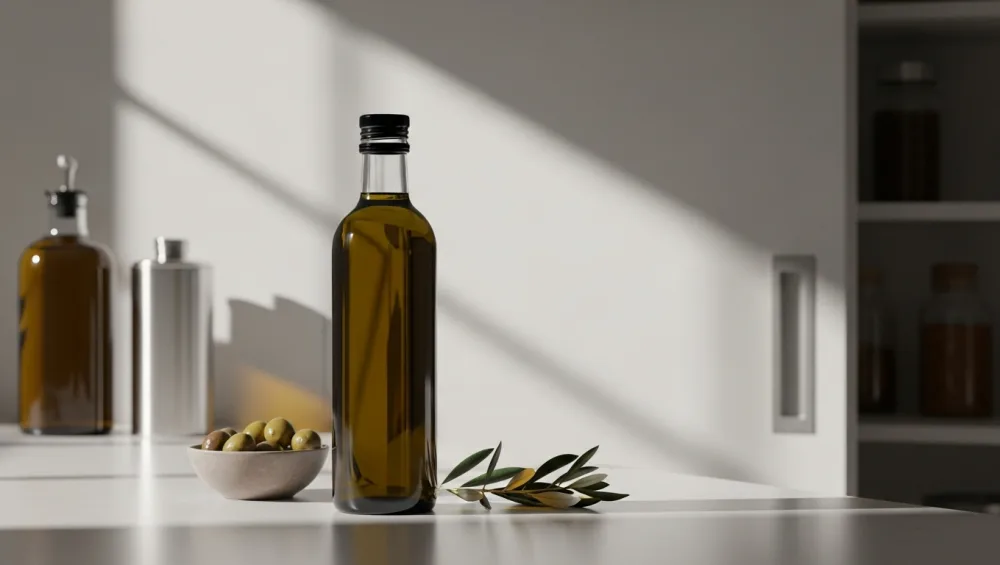
You spend money on olive oil. You research. You say “boutique,” you say “Aydın Memecik,” you even say “award-winning.” Then the bottle waits on the kitchen counter, right next to the stove, looking at daylight.
This is the most common story with olive oil: quality is won in production, but lost at home.
This piece takes the idea of “cold-pressed” beyond a label phrase and explains the practical way to truly protect the bottle.
Why Is “Cold-Pressed” Talked About So Much?
Because what we look for in olive oil is not just oil, but aroma, a sense of freshness, and a lively finish. When applied correctly, cold pressing helps preserve this character. That “green” impression when you open the bottle, the clean feeling that stays on the palate, these are all part of the world’s cold pressing promises.
But on one condition: you have to keep the bottle in the right conditions.
The Three Enemies of Olive Oil: Light, Heat, Oxygen
Think of olive oil as a living thing. Three elements slowly wear it down:
- Light: Fades the aroma.
- Heat: Speeds up the deterioration process.
- Oxygen: Enters every time the bottle is opened and starts a tiring pace.
There are small but effective moves against this trio.
“Where Am I Doing This Wrong?”
In many homes, olive oil falls into one of these scenarios:
- On the counter, close to daylight
- Next to the stove where it is exposed to heat
- The cap is loose
- A large bottle is opened and closed constantly
- A transparent bottle or packaging that lets in too much light
None of these look dramatic, but after a while you say, “Why doesn’t this oil feel the same?” Because the oil changes quietly.
The Most Practical Protection Routine
Think of this not as a list of rules, but as a small routine:
- Move the bottle to a dark, cool cabinet
The cabinet that gets the least heat in the kitchen is usually the best place. The area next to the stove is one of the worst options.
- Transfer the large bottle into a small daily-use bottle
This reduces oxygen contact. The large bottle is opened less, the small one is used daily.
- Close the cap tightly every time
Not “kind of closed,” but closed.
- Keep the bottle away from heat sources
Stove, oven, sunlit windowsills. Olive oil ages quickly in these places.
Why Is This More Critical for Aydın Memecik and Boutique Oils?
Because in oils with a distinct character like Memecik, the difference is felt sooner.
A well-protected Memecik carries its “green” signature for longer. A poorly protected one feels like its voice has been turned down: more muted, flatter, more tired.
Where Should Olive Oil Be Stored?
In a dark, cool cabinet, away from heat sources, with the cap tightly closed.
How Should Cold-Pressed Olive Oil Be Protected at Home?
By reducing exposure to light, heat, and oxygen: a dark cabinet, a small daily-use bottle, and a tight cap routine.